Claude Model
This section explains how to connect Anthropic Claude as a Gen AI Model data source in DataDios. Once connected, Claude can power AI Studio text-to-SQL, chat, insights, and metadata discovery, and can be bound to AI · reasoning in Manage → Integrations for the whole tenant.
Claude has no embeddings API, so it cannot be used as a RAG embedding source — keep OpenAI, Ollama, or Gemini for that. Everything else (chat, SQL generation, insights) works at parity with the other model connectors.
Prerequisites
Before connecting, get an Anthropic API key from the Anthropic Console under Settings → API keys. Optionally, create an Admin API key as well if you want the workload Cost dashboard to pull real usage and spend from Anthropic's Admin API.
Steps to Create and Test a Claude Data Source
Step 1: Create a Data Source
- Navigate to Data Explorer from the left navigation menu.
- Click + Add connection in the top-right corner. The Create data source dialog opens.
- Under Identity, enter a Name for the connection and select Claude Model from the searchable Type dropdown — it is listed under the Gen AI Models group.
Step 2: Fill Connection Details
In the Connection Parameters section, provide:
- Project Name: (Optional) a label to group your models under
- Provider Type: Direct Anthropic — the only provider available today
- Model Type: the Claude model to use (required, prefilled with
claude-opus-4-8). See Choosing a model below - Select Secret Source / Password: your Anthropic API key. Choose Direct Input to type the key here, or From Secret Store to reference a configured secret store
- A second Select Secret Source / Password pair: (Optional) an Anthropic Admin API key, used only to populate the workload Cost dashboard
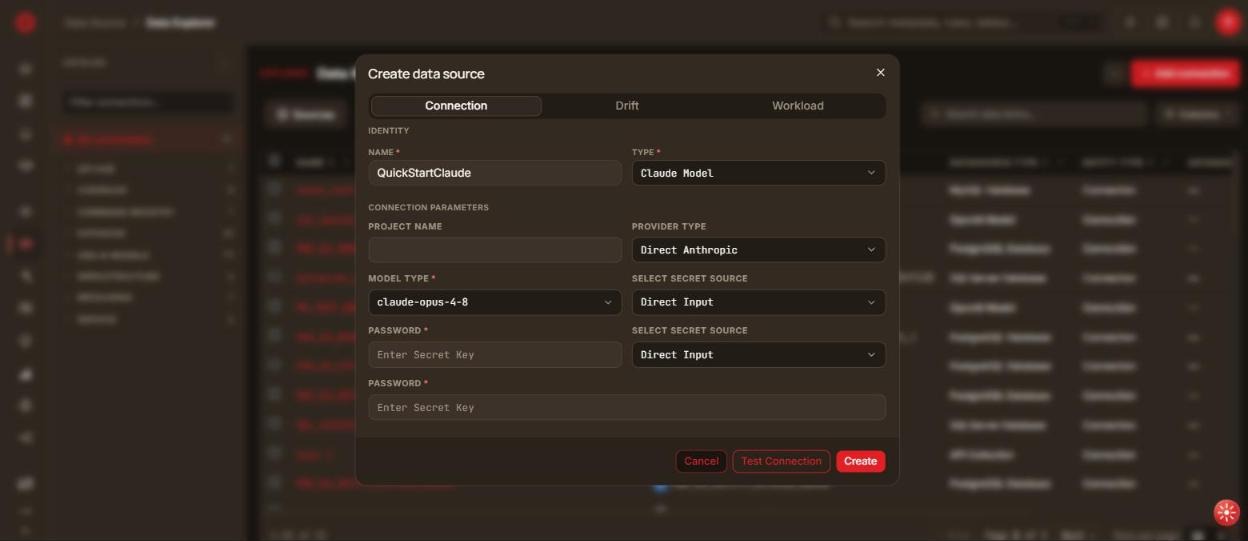
Both key fields carry the same Select Secret Source / Password labels, so they are told apart by position: the first pair is the API key, the second is the Admin API key.
The form marks both Password fields with an asterisk, but only the first one is actually required — leave the Admin pair empty if you don't need cost reporting. Without it the connection still creates and tests normally; only the Claude cost and usage workflows fail, reporting that an Admin key is needed.
The dialog also carries Drift and Workload tabs, both optional and both available later from Edit:
- Drift — toggle Enable drift tracking to record changes to the source in the drift timeline.
- Workload — toggle Enable workload analysis (and optionally Enable insight extraction), then pick from Claude Cost Workload, Claude API Usage Workload and LLM Usage Workload. The Claude Cost workflow is what consumes the Admin API key.
Claude has no Lineage or Profiling tab.
Step 3: Test Connection
Click Test Connection. A valid key is confirmed before you save; the key is never echoed back in any response or log.
Step 4: Save Data Source
Click Create. You land back on the Sources list, and the new connection appears under the Gen AI Models category in the left Catalog panel.
To change it later, click the Edit connection (pencil) icon on its row and save with Save instead of Create.
Choosing a model
The model_type dropdown is refreshed automatically from a public model catalog at server start, so newly released Claude models appear without a DataDios upgrade. Models that shipped with your release are always present regardless.
See Gen AI Model Catalog for how the list is kept up to date, what network access it needs on-premises, and what changes on upgrade.
Some Claude models do not accept the sampling parameters that others do. DataDios detects this and adjusts the request automatically — no configuration needed.
Using Claude with AI Studio
Once connected, select this data source in AI Studio to ask natural-language questions against your databases and get runnable SQL, chat over your data, and generate insights. See the AI Studio documentation.
To make Claude available to every user in your tenant without each user creating their own model source, bind it to AI · reasoning in Manage → Integrations.